
2025/03/14
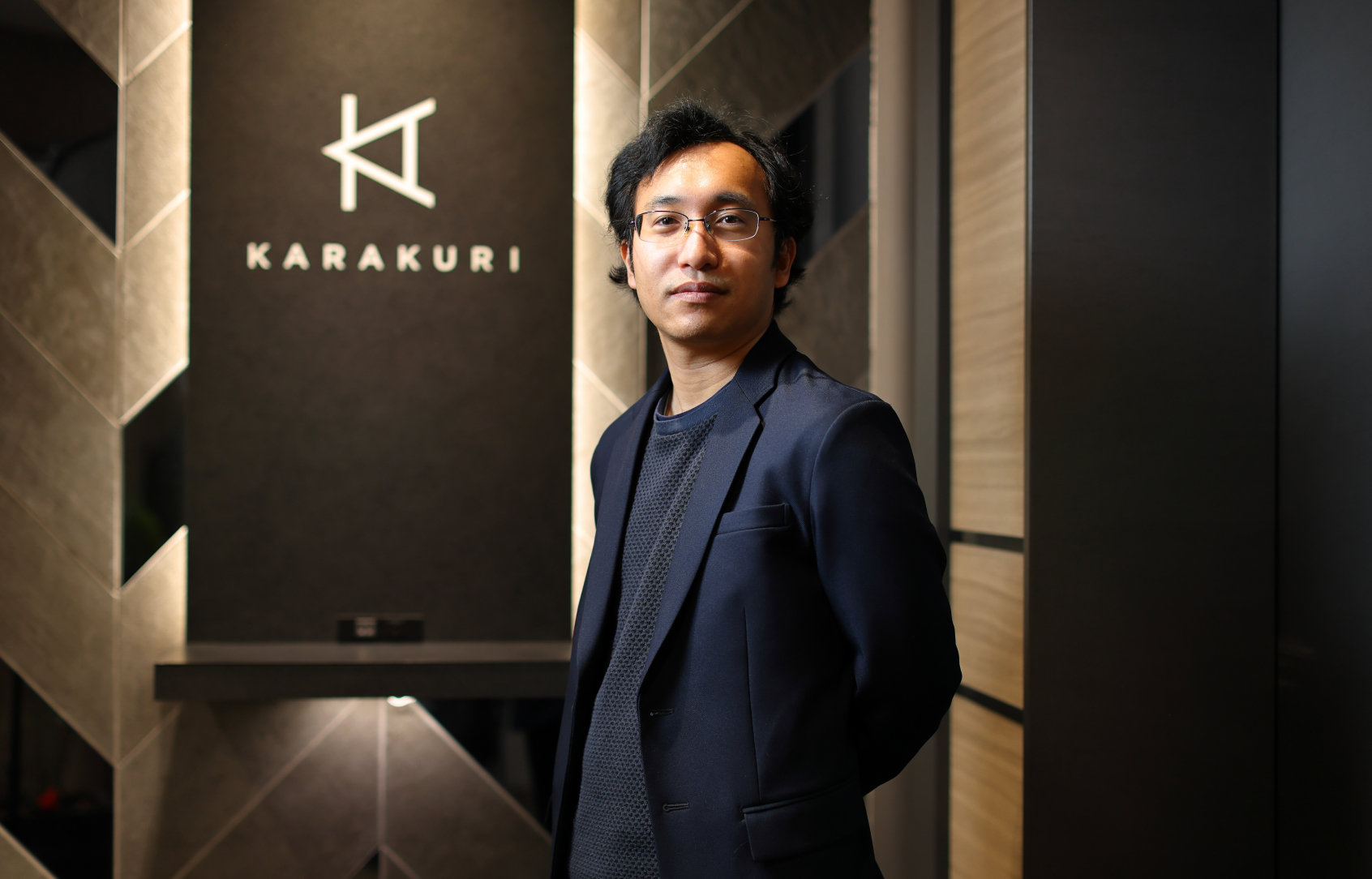
Who are the key figures behind GENIAC’s selected companies, which are tackling the research and development of domestically produced generative AI? This time, we spoke with Yuki Yoshida, Tech Lead at Karakuri Inc., an AI startup known for developing chatbot tools and more. Under GENIAC, the company is working on developing a high-quality AI agent model specialized for customer support. At the heart of this project is Yoshida, an unusual engineer who, while working as an AI engineer, also holds a medical license. We asked him about his first encounter with AI and his goals for the future.
Profile
Yuki Yoshida
Born 1989 in Hyogo Prefecture. Tech Lead at Karakuri Inc.
During high school, he competed in both the International Mathematical Olympiad and the International Olympiad in Informatics, winning silver medals in both. He later entered the University of Tokyo and obtained a medical license. Developing an interest in neuroscience, he enrolled in the University of Tokyo Graduate School in 2016 and began his career as a data scientist. In 2019, he joined Karakuri Inc. as Tech Lead. In 2024, Karakuri was selected as an awardee in the second phase of GENIAC’s computing resource support program. As the company’s Tech Lead, he is now taking on the challenge of developing a high-quality AI agent model.
A Path in Mathematics Abandoned Due to Parental Opposition, and the World of “Neuroscience” Discovered Through Medicine
──Mr. Yoshida, after entering the University of Tokyo, you obtained a medical license. What first brought you into contact with data science?
Yoshida: I’ve loved numbers for as long as I can remember, and in high school I was a member of the “Mathematics Research Club.”
While in school, I competed in the Mathematical Olympiad, where participants solve math problems, and won a silver medal. After that achievement, someone invited me to take part in the International Olympiad in Informatics, where high school students compete in programming skills, and I won a silver medal there as well. Still, my passion for mathematics remained strong, and even after entering the University of Tokyo I intended to pursue a career as a mathematician.
──But you entered the Faculty of Medicine at the University of Tokyo and obtained a medical license, correct?
Yoshida: That’s right. At the University of Tokyo, students decide their faculty placement in the fall of their second year, and at that time I could have chosen the path toward becoming a mathematician. But my parents strongly opposed it, telling me, “You can’t make a living with math.” So I decided to enter the Faculty of Medicine.
Once I committed to becoming a doctor, I studied medicine as hard as I could. But what I truly loved was mathematics and computers. I kept searching for a field where medicine and computers might intersect. That’s when I encountered neuroscience. The idea of unraveling the brain’s mechanisms with computers fascinated me. Knowledge of the brain could also be applied in medicine, so I thought, “This is it!”
After completing medical school and working as a resident, I went on to graduate school at the University of Tokyo. While conducting research on the brain, I realized that to understand the human brain, it was necessary to understand the “artificial neural networks” that underpin artificial intelligence (AI). That was when I began walking the path of a data scientist. Around that time, I met Tomofumi Nakayama, who was then CTO of Karakuri. We hit it off immediately, and I naturally became involved in Karakuri’s development efforts.
Joining Karakuri in the Peak of the Deep Learning Era
──Karakuri is a University of Tokyo–based AI startup. Meeting CTO Tomofumi Nakayama seems like it was partly coincidence, but also somehow inevitable.
Yoshida: That may be true. Karakuri was founded in October 2016, a time when interest in AI and deep learning was surging, and many AI-driven startups were emerging. I myself was deeply interested in deep learning. Karakuri chose to focus on chatbots and moved ahead with their development. Officially, I joined in 2019, but in reality, I had been involved in Karakuri’s development as an AI engineer since right after its founding.
I currently belong to Karakuri’s R&D division. To leverage AI, you need to make systems learn, and there are many ways to do that. Deep learning, machine learning, and other engineering methods are all options. My role is to determine the optimal approach from among those options and move forward with implementation.
──Are you involved in all of Karakuri’s development work?
Yoshida: Basically, yes. Karakuri’s aim is to support the entire customer support industry with technology—AI. But in fact, many companies have issues outside of customer support as well. We also propose AI-based solutions to help address those specific needs and challenges.
For example, chatbots are not just tools for automatically answering questions; they also help gather the Voice of the Customer (VOC). As users interact with services and note areas like “this part is unclear,” we’ve developed tools to automatically analyze such feedback. If VOC increases around a particular issue, the system can trigger an alert to inform administrators. I’ve been involved in building functions like that.
I also worked on developing an AI tool that instantly solves call center shift scheduling. This was based on “mathematical optimization,” a mathematical model I specialize in. Call centers employ many people, so shift schedules for a whole month need to be drawn up early on. Plus, call volume fluctuates by time of day, so staffing needs vary. On top of that, employees’ shift preferences must be reflected. Doing this puzzle manually can take about three days. With mathematical optimization, however, it can be completed in just seconds, which left our clients astonished.
The Greatest Joy Comes from Creating New Value and Seeing People Surprised
──As an AI engineer, what do you consider to be the real “joy” of your work?
Yoshida: In a word, I like surprising people. When people see what can be done with technology, they’re amazed. Bringing new value into the world in ways no one had imagined before—that’s where I find joy.
One example is the development of “KARAKURI LM,” a domestically produced large language model (LLM) series that achieves top performance among open Japanese models. OpenAI’s ChatGPT is certainly excellent, but it doesn’t fully meet the needs of Japanese customer support. That’s because Japanese is such a complex language and difficult to train AI on. For Japanese companies to use AI at a higher level, we truly need a domestically built LLM. At the same time, it helps prevent corporate information from leaking to foreign companies, so there’s also a strong security demand.
On the other hand, ChatGPT was what first sparked my deep interest in generative AI. When it was released in November 2022, I played around with it, and within just three days, I had created an original VTuber with AI-powered automated comment replies. I vividly remember how excited I was at the thought: “An era is coming where AI can do anything!”
──When you say we are in “an era where AI can do anything,” do you mean a period in time when AI will solve many of society’s challenges?
Yoshida: Yes, that’s exactly how I see it.
AI can be applied in countless situations. Going forward, I believe we’ll see the idea spread of using AI in areas where it hasn’t been used before. Put simply, if there are 10,000 challenges, then we can develop AI tools for each of those challenges. IoT stands for the Internet of Things, but when you add AI to that, you get what I call “AIoT.” I’m convinced we’re heading into an age where AI will be embedded in everything. Even vending machines might start talking and providing hospitality to users. There’s every chance that the future of AI use, in ways we haven’t even imagined, will continue to expand the world around us.
With GENIAC, Yoshida is Taking On the Challenge of Developing an Omnimodal LLM
──Karakuri is also one of the companies selected for GENIAC, the national project to strengthen Japan’s generative AI development capabilities. Could you tell us about your work there?
Yoshida: Karakuri’s greatest strength is using AI to support customer service. In this project, our goal is to evolve conventional LLMs—which mainly process text inputs—into an “omnimodal model” capable of handling multiple formats.
Traditional LLMs can only recognize text. For example, in an online meeting, even if documents are shared, they cannot understand the contents; if video is playing, they cannot comprehend it. But if we can equip AI with “eyes” to recognize visual information, it will be able to read shapes and graphs in documents or understand the content of videos.
If AI can accurately capture and understand information, it will be able to give more precise responses and advice. For example, in customer support, if speech recognition accuracy improves, AI could correctly interpret conversations and automatically display the exact information needed for operators on their screens. This would shorten response times for each interaction and reduce the burden on operators through greater efficiency. With this future in mind, we are working tirelessly on development every day.
Not Just Funding—The Newly Formed “Connections” through GENIAC Are a Major Advantage
──What benefits have you experienced from participating in GENIAC?
Yoshida: In GENIAC, we receive support for computing resources, which are expensive in development. This has been extremely helpful. AI development takes both time and money, so I think all the developers participating feel the same benefit.
Another major milestone has been the “connections” formed with other developers. At the GENIAC event I joined, we didn’t just share the challenges we faced during development and the knowledge we gained, but also encountered partner companies that could directly lead to business opportunities. It was an incredibly fruitful experience, and I truly feel it was the right decision to apply for the computing resource support program.
──Finally, could you share your outlook for the future?
Yoshida: There aren’t many companies like Karakuri that focus specifically on AI development for customer support. One reason for this is that our CEO, Oda, originally worked in customer support operations. We think from the customer’s perspective and provide solutions accordingly. There are other chatbot companies out there, but I believe we are the only company in Japan developing AI that truly addresses the fine-grained needs of the field.
We want to accelerate this unique approach and eventually become known as “the company synonymous with customer support DX.”
On a personal note, I am also interested in the application of AI in medicine. In fact, I still work as a physician once a week. Leveraging my medical experience, I would like to eventually take on the challenge of developing AI that can support healthcare.

