
2026/08/20
GENIAC supports a wide range of domestically developed generative AI research and development projects, and their outcomes are contributing to problem-solving through collaboration and co-creation with companies and local governments.
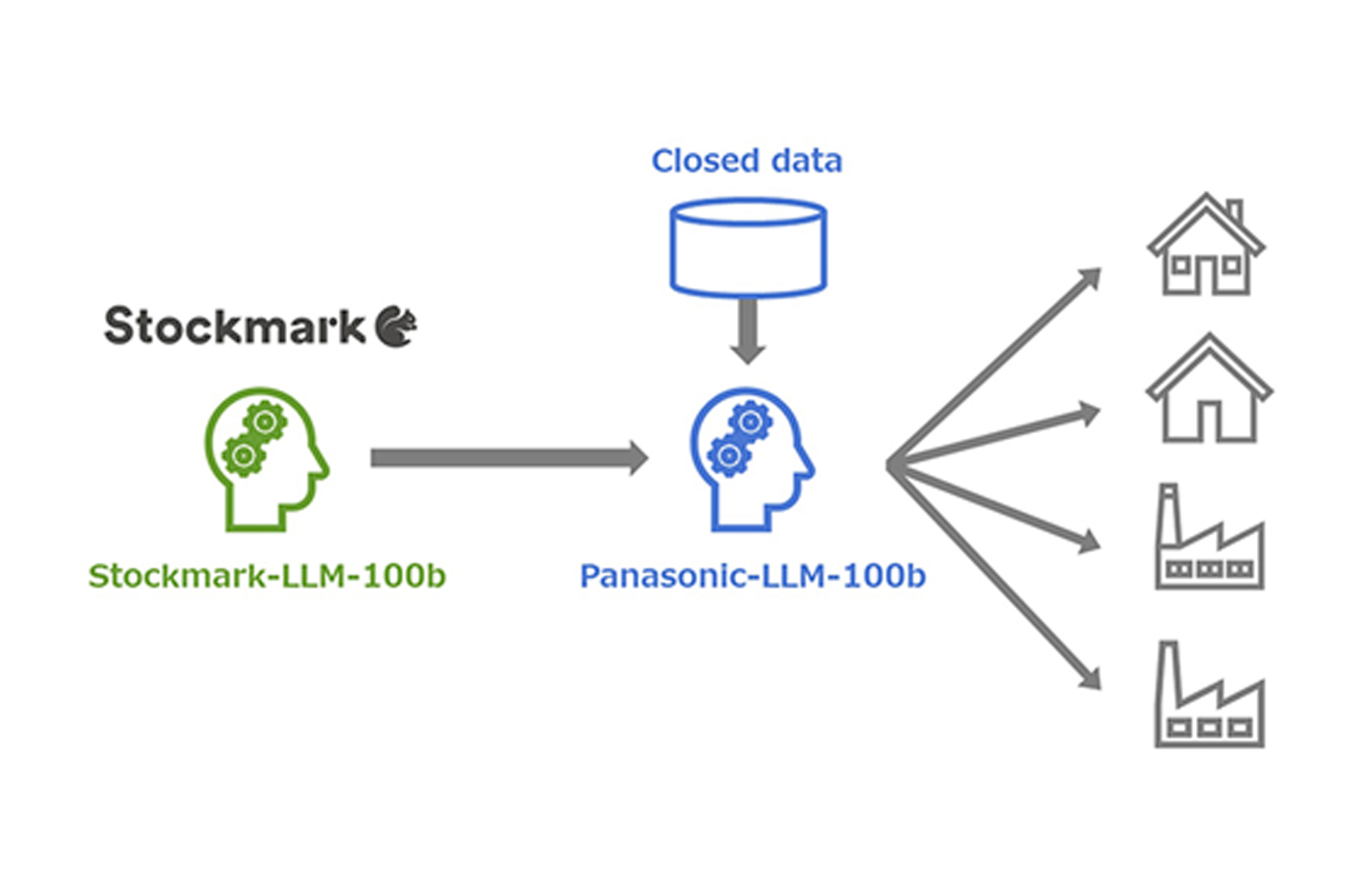
This case study highlights "Panasonic-LLM-100b," one of Japan's largest enterprise-specific large language models (LLMs), developed through collaboration between Panasonic Holdings Corporation (hereafter "Panasonic HD") and Stockmark Inc. The model is currently being introduced on a trial basis across various departments, factories, and business sites, contributing to improvements in operational efficiency.
A representative from Panasonic HD reflected that "meeting an excellent AI development partner, Stockmark, was a key factor in our success," and that "being selected under GENIAC was a decisive factor in the partner selection process." We spoke with the company about the background and objectives behind developing an in-house LLM for the group, as well as how the collaboration came about.
Profiles: The "Panasonic-LLM-100b" Development Team

Hiroshi Kutsumi
Senior Executive Fellow, in charge of AI Solutions, CX Innovation Division; Deputy Head, Lifestyle Product Innovation Division, Living Appliances Company, Panasonic Holdings Corporation. He is responsible for driving the broad deployment of AI and digital technologies across the Panasonic Group.
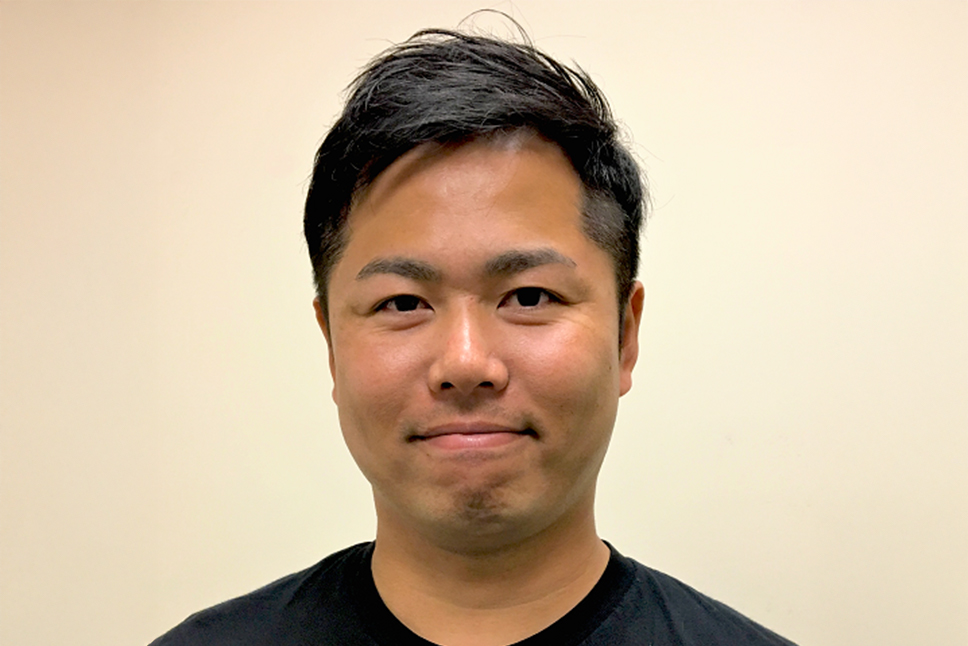
Kazuki Kozuka
Manager, AI Solutions Department (Section 1), Digital & AI Technology Center, DX & CPS Division, Panasonic Holdings Corporation. He is engaged in the development of foundation models and large language models (LLMs) and leads the development of "Panasonic-LLM-100b."
Profile: Stockmark Inc.
About Stockmark Inc.
Stockmark Inc. is an AI startup specializing in natural language processing. Leveraging its technology, the company provides services such as "Anews," which classifies business news from approximately 35,000 sources in Japan and overseas and delivers AI-curated information directly relevant to business operations. Its mission is to "reinvent the mechanism of value creation and advance humanity."
Under GENIAC, Stockmark developed "Stockmark-LLM-100b," a large language model (LLM) that significantly reduces hallucinations. Based on this model, the company collaborated with Panasonic Holdings Corporation to develop "Panasonic-LLM-100b," one of Japan's largest proprietary Japanese-language LLMs tailored for enterprise use. This initiative represents a successful example of enterprise-specific LLM development in Japan.
Hallucinations as a Barrier to Enterprise AI Adoption
—Panasonic HD has developed its own large language model (LLM) in collaboration with Stockmark. Why was it necessary to develop a proprietary LLM?
Kutsumi: It is said that by 2025, the volume of data we use will reach approximately 180 zettabytes—about twice the level of three years ago. Of this, only around 20% is open data that we can easily search. The remaining roughly 80% consists of business-related closed data stored within companies.
General-purpose LLMs are primarily trained on that 20% of accessible data, which means they are not fully suited for business use. In addition, so-called "hallucinations"—plausible but incorrect outputs characteristic of AI—pose a significant barrier to practical adoption in enterprise settings. As a result, many organizations want to adopt AI but find themselves unable to do so effectively.
Against this backdrop, Panasonic HD initiated the development of a proprietary LLM trained on its own internal data.
AI Adoption as an Urgent Group-Wide Challenge
—Panasonic is one of Japan's leading comprehensive electronics manufacturers. With Panasonic HD now advancing the development of a proprietary LLM, can this be seen as a first step toward promoting AI utilization across the entire group?
Kutsumi: Yes. Since its founding in 1918 by Konosuke Matsushita, Panasonic has undergone various changes in its corporate name and organizational structure while delivering innovative products and solutions across a wide range of fields, including home appliances, housing, automotive, industrial systems, communications, and energy. In 2022, we transitioned to an operating company structure. This initiative took the form of a group-wide project spanning multiple group companies, aimed at advancing AI adoption and utilization.
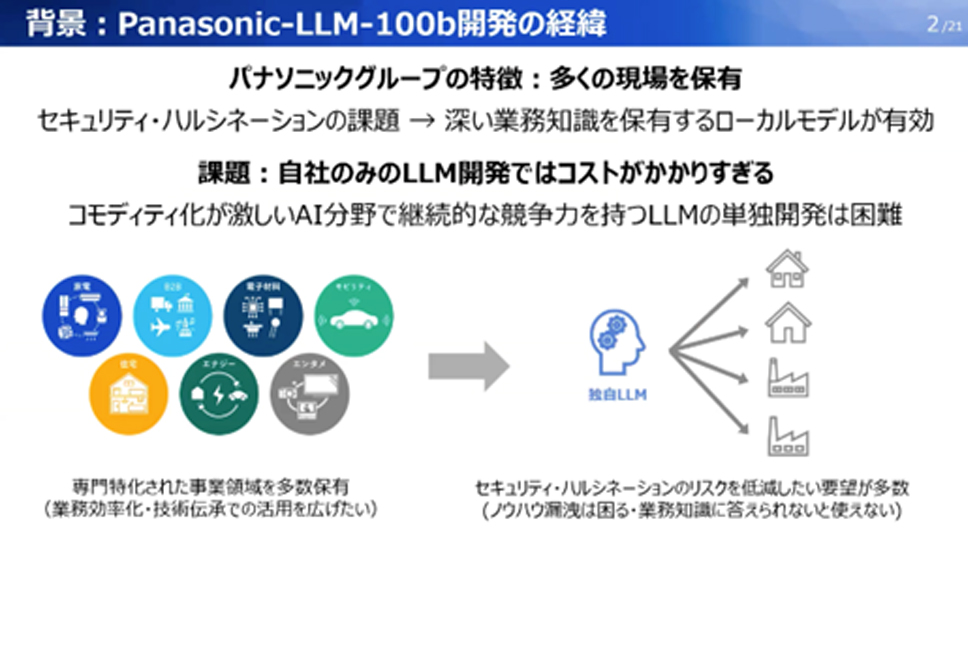
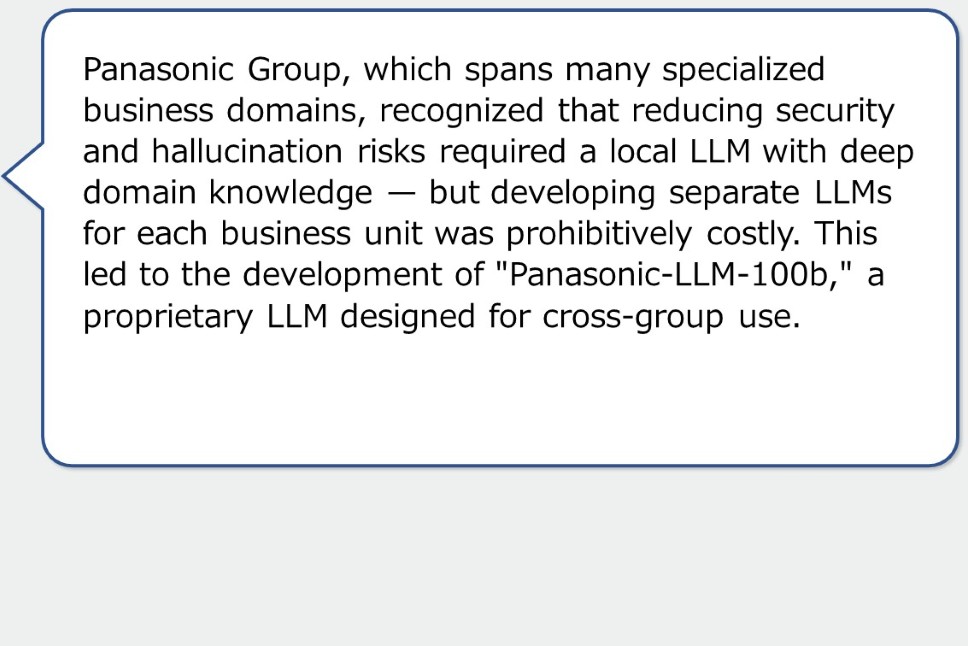
Kozuka: One defining characteristic of the Panasonic Group is the breadth of its business domains, as it provides specialized products and solutions across many different fields. While each business area has accumulated its own expertise and history, sharing that knowledge across the group has not been easy. This led us to focus on AI as a means to address the challenge. In addition, we have been receiving an increasing number of inquiries from various departments seeking to solve challenges using AI—amounting to around 100 cases per year—making AI adoption an urgent priority for Panasonic HD.
However, there were also challenges related to security. In particular, for business use, the accuracy of information is critically important. General-purpose LLMs lack sufficient knowledge about Panasonic Group products, making them unsuitable for practical use. At the same time, developing an LLM entirely in-house would require excessive cost and time, posing another significant hurdle.
—Generative AI tools such as ChatGPT, which are based on general-purpose large language models (LLMs), are highly convenient, but they also frequently produce plausible yet incorrect information (hallucinations), making them difficult for enterprises to adopt easily.
Kutsumi: That's right. If we can effectively leverage LLMs, they could enable things like the transfer of technical expertise. However, if the information they provide is incorrect, it becomes meaningless. With this in mind, we hypothesized that a smaller language model (LM), trained exclusively on accurate information and domain-specific business knowledge, could be an effective way to reduce hallucinations.
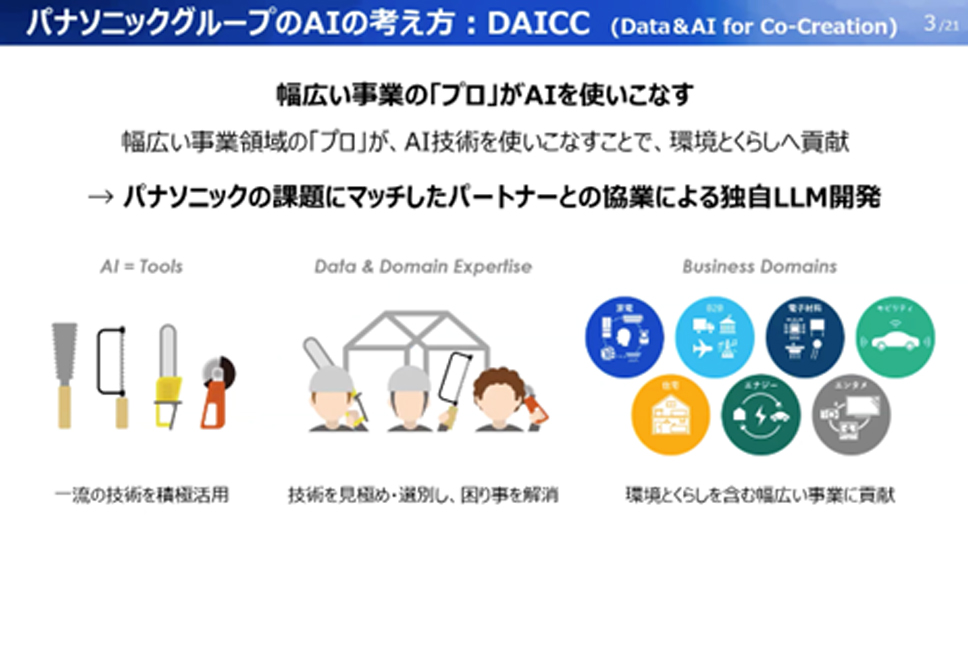
Kozuka: Within the Panasonic Group, our approach to AI is guided by the concept of "DAICC (Data & AI for Co-Creation)." It can be translated as "leveraging AI for co-creation." The idea is to have AI learn from top-tier expertise so that professionals across a wide range of business domains can use AI to solve more challenges and contribute to their businesses in various ways. However, it is difficult to independently develop an LLM capable of realizing this vision. That is why we began searching for a partner and ultimately decided to collaborate with Stockmark.
The Decisive Factors for Collaboration: Advanced Technical Capabilities and Selection Under GENIAC
—What led to your collaboration with Stockmark, and what were the key deciding factors?
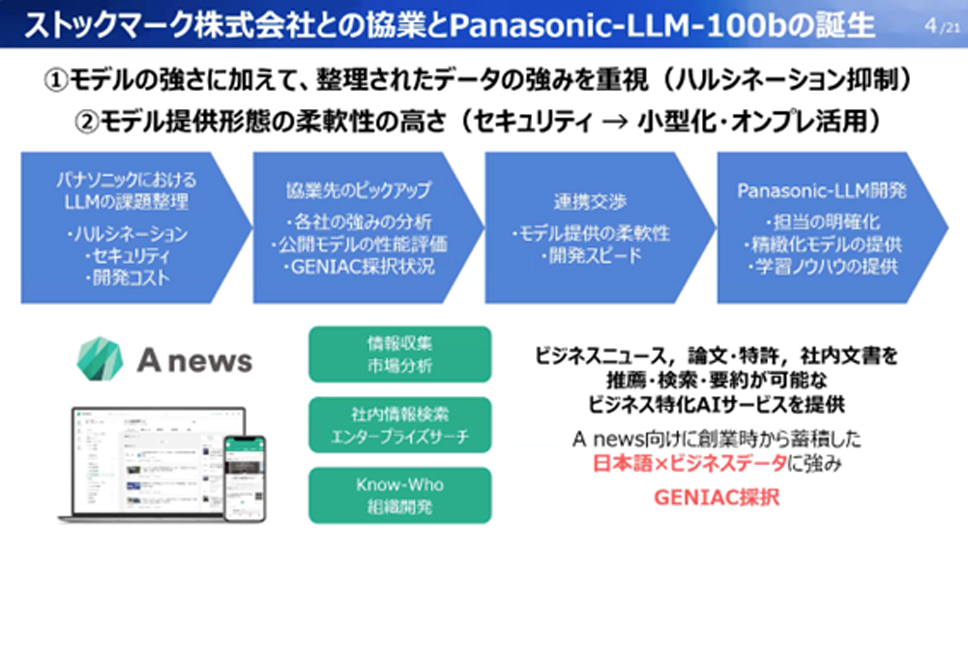
Kutsumi: In selecting a partner, we looked not only for a high-performing LLM, but also for access to data designed to suppress hallucinations. In addition, as mentioned earlier, we placed great importance on flexibility—the ability to customize solutions to fit the diverse business domains and on-site needs across Panasonic HD.
Stockmark had developed "Stockmark-LLM-100b," an LLM that significantly reduces hallucinations, and its performance was outstanding. Furthermore, through its business-focused AI service "Anews," the company has built strong capabilities in Japanese-language business data. Its selection for GENIAC, a project led by the Ministry of Economy, Trade and Industry, further reinforced our impression of its technical capabilities and reliability, which led us to initiate discussions on a collaboration.
Kozuka: In general, many companies in Japan developing their own LLMs tend to adopt smaller models with around 7 to 13 billion parameters. In contrast, this initiative involves the development of one of Japan's largest LLMs, with approximately 100 billion parameters, trained on the vast amount of internal data held by the Panasonic Group. We believe this was made possible by our partnership with Stockmark.
With the provision of the base model and support in training know-how, we proceeded with the development of a model tailored specifically for Panasonic HD. This involved training the model on our proprietary product and technical information and fine-tuning it according to the needs of each business domain. Given the complexity of working with LLMs, we are deeply grateful for Stockmark's consistent support, characterized by responsiveness, flexibility, and speed throughout the process.
The Reliability of a Proprietary LLM That Avoids Hallucinations
—The LLM "Panasonic-LLM-100b," developed in collaboration with Stockmark, has already been introduced on a trial basis at Panasonic HD's business sites and factories, correct?
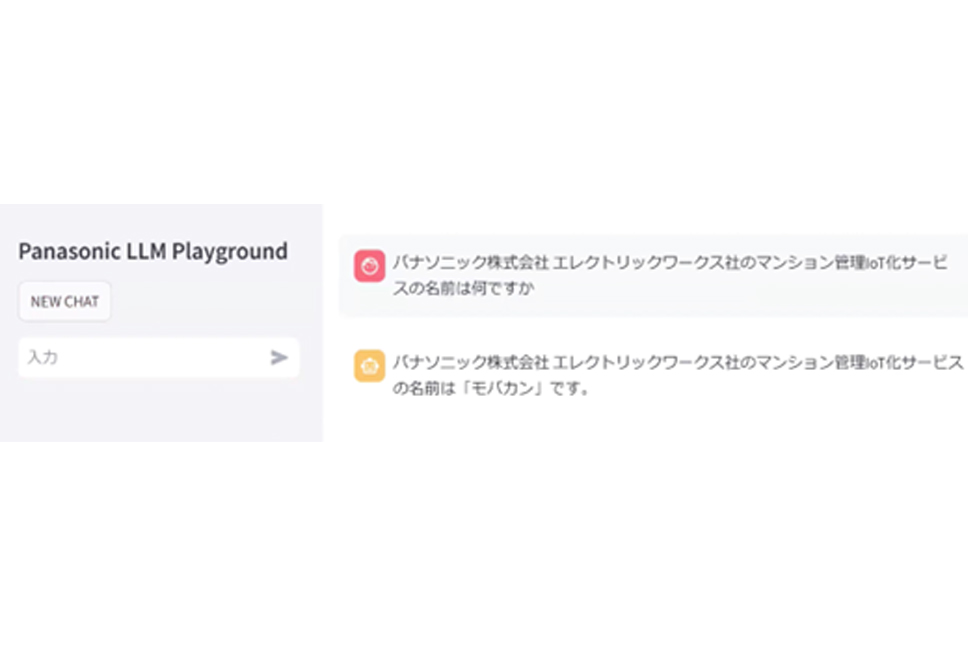
Kozuka: Yes. Let me share an example of how Panasonic-LLM-100b responds. When a question is entered, an answer is generated immediately.
However, when the question involves Panasonic-specific service names, general-purpose LLMs such as GPT-4o lack accurate knowledge and tend to produce plausible but incorrect answers—resulting in hallucinations. In some cases, they may also refuse to answer questions related to the latest information or current events, meaning no response is provided.
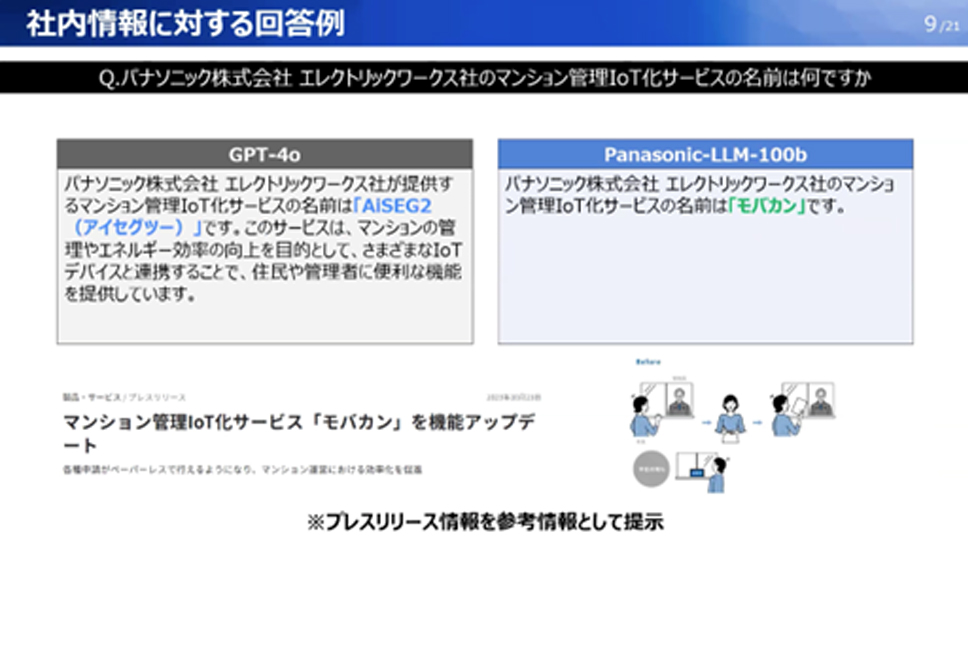
In contrast, Panasonic-LLM-100b has been trained extensively on Panasonic-related data, so the kinds of hallucinations or refusals to answer seen in these examples do not occur. This enables users to reliably obtain accurate information.
Kutsumi: In addition, we are currently developing a language model (LM) to support troubleshooting for factory equipment. With an LM specialized for factory environments, we expect workers to be able to resolve questions immediately, leading to improved productivity.
—From the use cases you've shown, it seems that without an LLM customized for internal use, it would be difficult to rely on it with confidence.
Kutsumi: That said, we are not rejecting general-purpose LLMs. We believe each has its appropriate use cases. For broad applications of generative AI, general models such as ChatGPT are naturally viable options. However, for Panasonic's business operations, we position Panasonic-LLM-100b as the more appropriate choice.
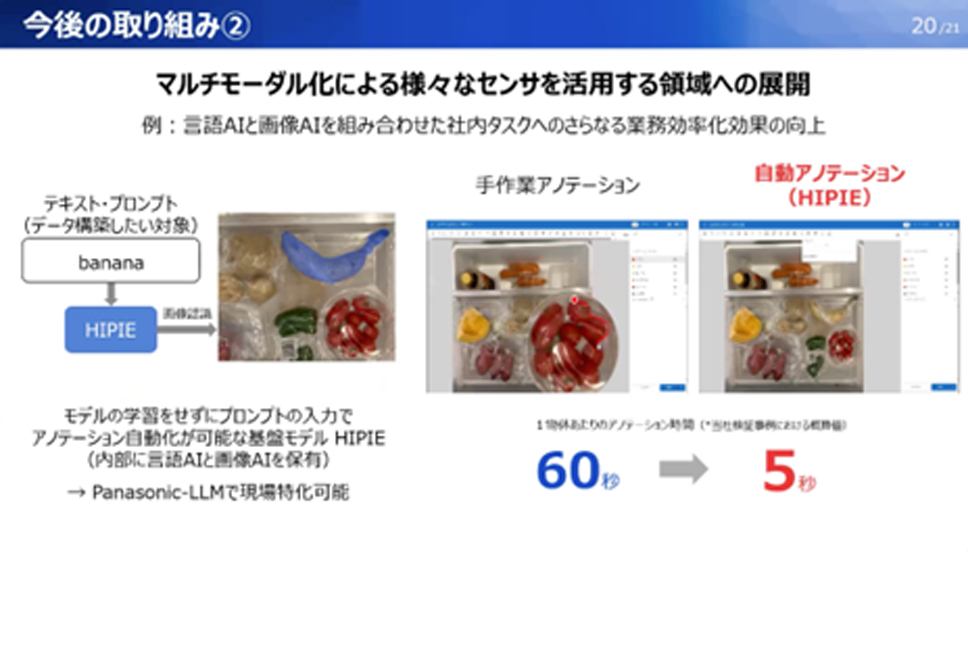
Kozuka: At present, Panasonic-LLM-100b supports only text-based formats. Going forward, we plan to expand into multimodal capabilities, including image processing, so that the system can automatically recognize visual information related to Panasonic products and further improve operational efficiency in internal tasks. We are already developing "HIPIE," which integrates both language and image AI, and by combining it with Panasonic-LLM-100b, we aim to extend its applications to include image recognition. In addition, if we can support voice input in the future, it will open up even more convenient use cases in factory environments. We intend to continue development with a long-term perspective in mind.
In an Era Where Not Using AI Poses Greater Risk: A Call to Take on Proprietary LLM Development
—Finally, what message would you like to share with companies considering the development of their own proprietary LLMs?
Kozuka: Developing an LLM independently can be challenging, but with the right partner, it is certainly achievable. In our case, that partner was Stockmark. Depending on specific needs and use cases, there will be an optimal partner for each company. I would recommend starting by identifying the right partner.
Kutsumi: Introducing AI requires both time and cost, and it can be difficult to clearly see the return on investment (ROI). In the past, there was also skepticism toward AI adoption itself, but that is no longer the case. Today, the greater risk lies in not using AI—there is a growing sense of urgency about being left behind if it is not adopted. If falling behind in AI adoption could become a management risk, then this may no longer be a time when it is appropriate to focus solely on ROI. From the perspective of strengthening Japan's industries, we strongly encourage many companies to take on the challenge of developing their own proprietary LLMs.
Comment from Tatsu Hayashi, Representative Director and CEO, Stockmark Inc.

"For companies to leverage large language models (LLMs) and generate new business impact, it is essential to utilize their own data and build LLMs tailored to their specific business characteristics. Our collaboration with Panasonic HD represents a successful example of this approach. Going forward, we hope that companies across a wide range of industries will take on the challenge of developing their own proprietary LLMs.
At Stockmark, we develop LLMs for business applications that offer a greater depth of knowledge and stronger hallucination suppression capabilities than general-purpose models. In addition, we have developed technologies for efficient continual pre-training that prevent catastrophic forgetting. Through initiatives like this, we hope to contribute to the advancement of enterprise-specific LLM development in Japan."

